Proof of Loss: What It Is and Why Missing It Can Jeopardize Your Claim
How missing a Proof of Loss form can jeopardize your claim.
Proof of Loss: What It Is and Why Missing It Can Jeopardize Your Claim
Most homeowners filing a claim have never heard of a Proof of Loss. It's not prominently mentioned in the initial claims call, it doesn't appear in most adjuster communications, and it's easy to overlook in a dense policy document. But in many policies, it's a contractual requirement with a real deadline — and missing it can give your insurer grounds to complicate or deny an otherwise legitimate claim.
What Is a Proof of Loss?
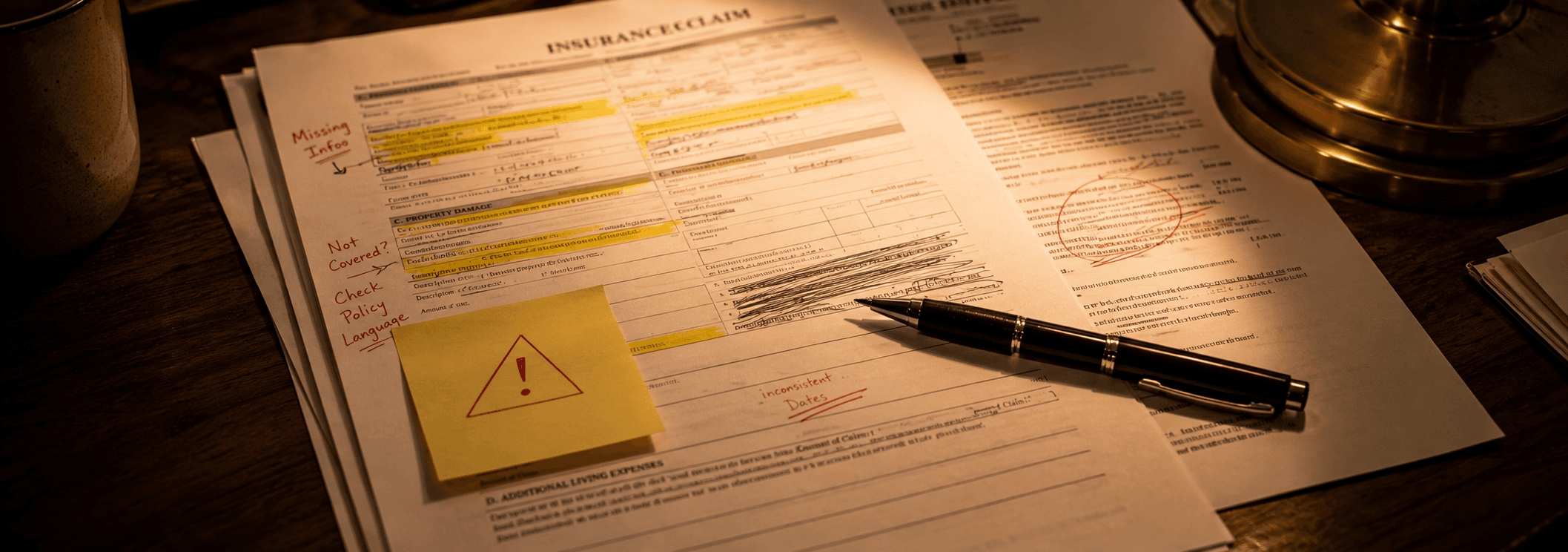
A Proof of Loss is a formal, sworn statement submitted to your insurer specifying the details of your claim — what was damaged or lost, when the loss occurred, the cause, and the dollar amount you're claiming by coverage category.
Unlike the initial report of loss — which is a notification that the event happened — a Proof of Loss is a formal legal document. It's typically signed under oath and notarized. Submitting a materially false Proof of Loss can void your coverage entirely, which is why accuracy matters as much as timeliness.
Is a Proof of Loss Always Required?
No — and this is where many homeowners get confused. Whether a Proof of Loss is required depends on your specific policy and your state's laws.
Some policies require a Proof of Loss for all claims. Others require it only in specific circumstances — after a denial, after a dispute about scope, or when the claim exceeds a certain threshold. POL requirements come from your policy and may be affected by state law — confirm your policy's requirement and deadline directly with your insurer in writing rather than relying on a general rule.
The way to know: read your policy's Conditions section carefully. Look for language about "proof of loss," "sworn statement," or "your duties after a loss." If it's there, it's a requirement — regardless of whether your insurer mentions it.
Critically: don't assume that because you haven't received a Proof of Loss form, you don't have an obligation. Some insurers proactively send the form. Others expect you to request it or prepare your own. The absence of a form doesn't mean the requirement doesn't exist.
What Is the Deadline and What Happens If You Miss It?
Most policies that require a Proof of Loss specify a timeframe — commonly 60 days from the date of loss. Some policies give 90 or 120 days. State law sometimes extends these periods or modifies how strictly they can be enforced.
The consequences of missing the deadline vary by state. In some states, an insurer can deny coverage based solely on a late Proof of Loss. In many others, they must demonstrate actual prejudice from the delay — that the late submission actually harmed their ability to investigate or respond — before they can deny coverage on that basis.
But "my state has a prejudice requirement" is not a reliable defense strategy. It's a legal argument that requires professional help to make effectively. The better approach is to know the deadline and meet it.
What Goes Into a Proof of Loss?
Standard Proof of Loss documents include:
- Policyholder identification: name, address, policy number, claim number
- Date, time, and cause of loss — accurately and specifically stated
- Description of the insured property and your interest in it
- Itemized statement of the loss by coverage category — what was damaged, with dollar values based on your documentation
- Disclosure of other insurance that may apply to the same loss
- Mortgage or lienholder information if applicable
- Signature under oath — typically requires notarization
The itemized statement is the substantive core — it requires that your damage inventory, contractor estimates, and contents documentation be reasonably complete before you can prepare it accurately. This is another reason to document thoroughly from day one.
How Do You Handle the Proof of Loss Requirement?
Step 1: On your first call with your insurer, ask directly: "Does my policy require a Proof of Loss? When is it due? Can you send me the required form or template?" Get the answer documented.
Step 2: Calendar the deadline immediately — the day you open the claim.
Step 3: Build your documentation. Your itemization should be based on your damage inventory, contractor estimates, and contents records. Don't rush to submit an incomplete Proof of Loss — accuracy is required.
Step 4: If you need more time, request an extension in writing before the deadline. Explain the specific reason — documentation not yet complete, contractor estimate pending — and request a defined additional period.
Step 5: Have the document notarized. Submit via certified mail with return receipt requested. Retain a complete copy.
Frequently Asked Questions
Does submitting my claim form satisfy the Proof of Loss requirement? Usually not. A claim form is typically a notification of loss. A Proof of Loss is a formal sworn statement with specific legal requirements. They're separate obligations under most policies. Ask your insurer explicitly whether your claim form substitutes for or satisfies the Proof of Loss requirement.
What if my insurer waives the Proof of Loss requirement? Get the waiver in writing. Whether a POL is required in practice varies. Treat the policy requirement as live unless you have a written waiver. An oral waiver from a claims representative is not reliable documentation of a waiver.
Can I submit a Proof of Loss before all damage is known? You can submit what you know and supplement later as additional damage is discovered. However, the Proof of Loss should represent your full known loss at the time of submission. An intentionally incomplete Proof of Loss that omits known damage could create complications.
What if the Proof of Loss deadline has passed? Contact your insurer immediately, explain the circumstances, and ask what options remain. Research your state's prejudice requirement. If significant coverage is at stake, consult an insurance attorney before the insurer responds to your inquiry.
Does the Proof of Loss need to include my ALE expenses? It depends on your policy — some require ALE to be included; others treat it as a separate ongoing claim. Ask your insurer whether your Proof of Loss should include ALE and how ongoing ALE is handled relative to the formal Proof of Loss submission.
Proof of Loss Checklist
- Read your policy's Conditions section for Proof of Loss requirements before assuming none exists
- Ask your insurer on the first call: "Is a Proof of Loss required and when is it due?"
- Calendar the deadline the day you open the claim
- Build your documentation: damage inventory, contractor estimates, contents records
- Request an extension in writing before the deadline if you need more time
- Have the document notarized and submit via certified mail — retain a copy
- Get any waiver of the Proof of Loss requirement in writing
ClaimEase provides general guidance. Coverage determinations are made by your insurer. Consult a licensed public adjuster or attorney for specific advice about your claim.