What to Do in the First 72 Hours After Home Damage: The Emergency Checklist
The complete emergency checklist for the first 72 hours after home damage — step by step, in order.
What to Do in the First 72 Hours After Home Damage: The Emergency Checklist
The first 72 hours after home damage are where the claim gets won or lost. Not because the insurer is making decisions yet — they're not. Because you are. The documentation you build, the expenses you track, and the contractor estimates you line up in this window determine your position for everything that follows.
Work through this in phases. Every one matters.
Hours 0–6: Safety and Emergency Response
Get everyone safe first.
- Evacuate immediately if there's structural compromise, fire, gas smell, or active flooding
- Call 911 for any emergency requiring fire, medical, or police response
- Don't re-enter until emergency services confirm it's safe
- Shut off utilities only if you can do so safely — gas at the meter, water at the main valve, electricity at the breaker panel
Stop the damage from spreading.
Most policies include a duty to mitigate — you're expected to take reasonable steps to prevent additional damage after the initial event. Failure to do so can give your insurer grounds to dispute damage that occurred after the loss.
- Water damage: shut off the source, move valuables out of the flood path
- Roof damage: tarp exposed areas if safe — never go on a wet or structurally compromised roof
- Fire damage: secure openings from weather once the fire is out
- Storm damage: board up broken windows and doors
Save every receipt from emergency mitigation. Water extraction, tarps, board-up, emergency plumbing — these are typically reimbursable under your dwelling coverage but require documentation to claim.
Hours 6–24: Document Everything
Document before you touch anything. This is the rule that matters most in this entire window. Once damage is cleaned up or repaired, the original evidence is gone.
Build your photo and video record:
- Wide shots of every affected room from the doorway — at least three angles each
- Close-up shots of specific damage: waterlines, structural failures, impact points, burned materials
- Narrated video walkthrough of every affected area — say the date and time aloud at the start, walk slowly, describe what you see
- Damaged personal property in place, before anything is moved
- Serial numbers on all damaged appliances and electronics
- All exterior damage: roof, siding, fencing, outbuildings, vehicles
Don't discard anything yet. Damaged items are evidence. Photograph everything before disposal and wait for adjuster authorization on significant items. Discarding property without authorization can exclude it from your contents claim entirely.
Start your written damage inventory. For each damaged area and item: location, description, estimated age, approximate replacement value. This detail feeds directly into your contents claim — the more specific, the stronger your position.
Hours 24–48: File and Notify
Call your insurer's claims line.
Most policies require prompt notice — waiting beyond 48 hours creates risk even for clearly covered losses. When you call:
- Have your policy number, date and cause of loss, and a general description of damage ready
- Be specific about the cause: "a pipe burst behind the bathroom wall" not "water damage"
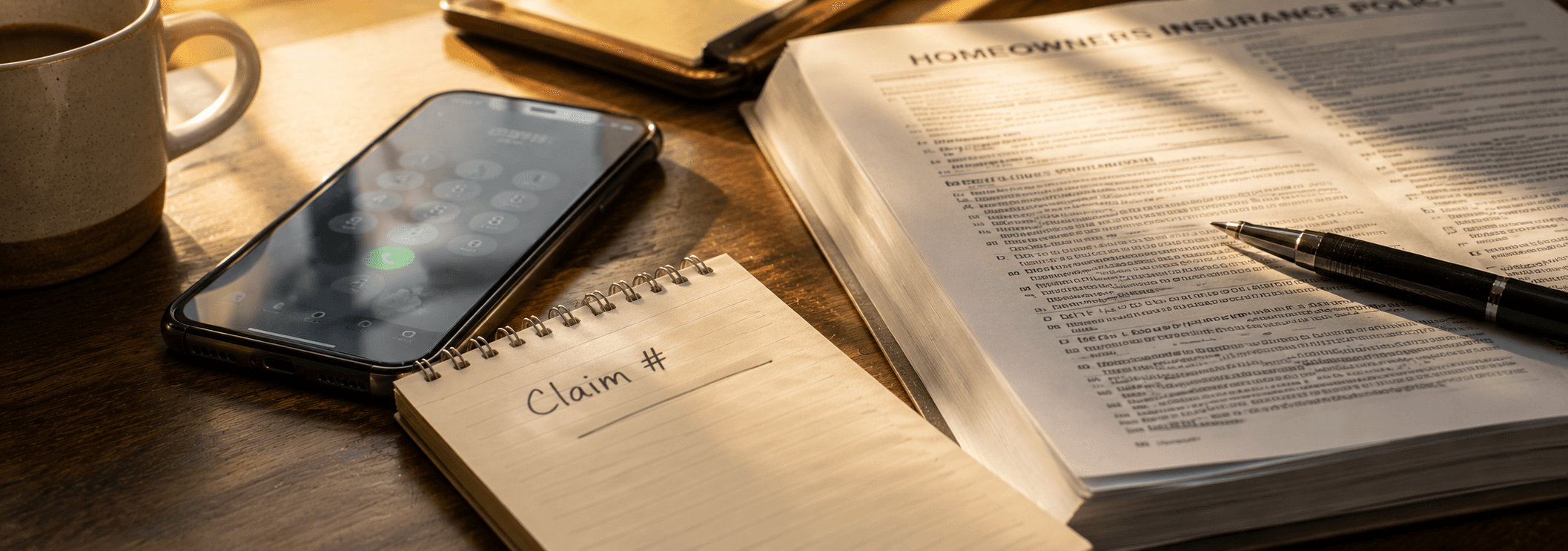
- Ask for your claim number before hanging up
- Ask what your ALE limit is if your home is uninhabitable
- Ask whether emergency mitigation expenses are reimbursable and the submission process
Start your claim log immediately. Every conversation from this point forward — date, who you spoke with, what was discussed, what was committed to and by when. Follow up every significant call with a brief email summary. This log is your primary protection if the claim gets complicated over the months ahead.
Notify your mortgage servicer for any significant structural loss. Your lender is almost certainly listed as a loss payee — structural claim checks will be issued jointly to you and your servicer, and you'll need their endorsement to deposit them. A five-minute call now prevents a significant delay later.
Arrange temporary housing if your home is uninhabitable. Your ALE coverage — typically 20-30% of your Coverage A limit — covers the increase above your normal living costs from the date of loss. Track every displacement expense with receipts from tonight: hotel costs above your normal housing expense, meals above your typical food budget, laundry, storage, pet boarding. ALE runs from the date of loss regardless of when you start submitting receipts.
Hours 48–72: Get Organized and Get Ahead of the Adjuster
This phase is where prepared homeowners separate from unprepared ones.
Get at least one independent contractor estimate before the adjuster visits.
This is the step most homeowners skip, and it's one of the highest-value things you can do. A licensed contractor walkthrough before the adjuster inspection gives you a benchmark — a specific, written estimate of what the repairs actually require. When the insurer's scope comes in at 60% of your contractor's number, you have something concrete to point to.
Schedule it now. After a regional weather event, licensed contractors book out within days.
Review your policy before the adjuster arrives.
Know your deductible. Know your coverage types — Coverage A (dwelling), C (personal property), D (ALE). Know whether your policy is HO-3 or HO-5, which affects how personal property is covered. Know whether you have replacement cost value or actual cash value coverage — this single distinction determines whether your initial payment is the full settlement or just the first installment.
Understanding these basics before the adjuster arrives means the conversation happens on your terms, not theirs.
Organize your documentation by category:
- Damage photos organized by room or area, labeled with dates
- ALE receipts separate from repair and mitigation receipts
- Policy documents and declarations page
- Contractor estimates as they come in
- Communications log
Back up everything to cloud storage. Don't keep the only copy on a phone that could be damaged or reset during an already stressful period.
Prepare your damage walkthrough list for the adjuster.
Go room by room and write down every area of concern — including damage you're uncertain about. Your job during the inspection is to make sure nothing gets overlooked. It's significantly harder to add items to scope after the inspection than before it.
Frequently Asked Questions
What's the difference between what to do in the first 24 hours versus the full 72 hours? The first 24 hours are about crisis response: safety, stopping the spread, documenting the original damage, and getting the claim filed. Hours 24-72 shift to preparation: getting contractor estimates, reviewing your policy, and organizing your documentation before the adjuster arrives. The 72-hour window is when informed homeowners build the position they'll hold for the rest of the claim.
Do I need to hire a contractor in the first 72 hours? For emergency mitigation — water extraction, tarping, board-up — yes, immediately. For repair estimates, aim to have at least one independent contractor assessment scheduled within 48-72 hours. Getting estimates before the adjuster's inspection is significantly more useful than getting them after.
Can I stay in a hotel without prior insurer approval? Yes. If your home is uninhabitable, you don't need adjuster approval to arrange housing. Document that the home was uninhabitable (photos, emergency services confirmation, contractor statement) and keep all receipts. ALE reimbursement is triggered by the uninhabitable condition, not by prior authorization.
What if I can't get a contractor to come out in 72 hours? Call multiple contractors — at least three — and document your attempts. After a major weather event, schedule immediately even if the appointment is several days out. An estimate scheduled for day 5 or 6 is still far more useful than one you start pursuing after the adjuster has already produced their scope.
How do I track ALE expenses correctly? Keep receipts for all displacement-related costs: hotel, meals, laundry, storage, pet boarding. Note your normal baseline costs so you can calculate the increase — ALE covers the excess above normal, not the total. Separate ALE receipts from repair and mitigation receipts from day one. Mixing them causes reimbursement complications later.
72-Hour Emergency Checklist
- Hours 0–6: Safety first, then mitigate — save every mitigation receipt
- Hours 6–24: Document everything before cleanup — photos, video, written inventory — don't discard anything without authorization
- Hours 24–48: File the claim, start the log, notify your mortgage servicer, arrange housing and track ALE from tonight
- Hours 48–72: Get a contractor estimate, review your policy, organize documentation, prepare your adjuster walkthrough list
- Back up all files to cloud storage — don't rely on a single device
ClaimEase provides general guidance. Coverage determinations are made by your insurer. Consult a licensed public adjuster or attorney for specific advice about your claim.